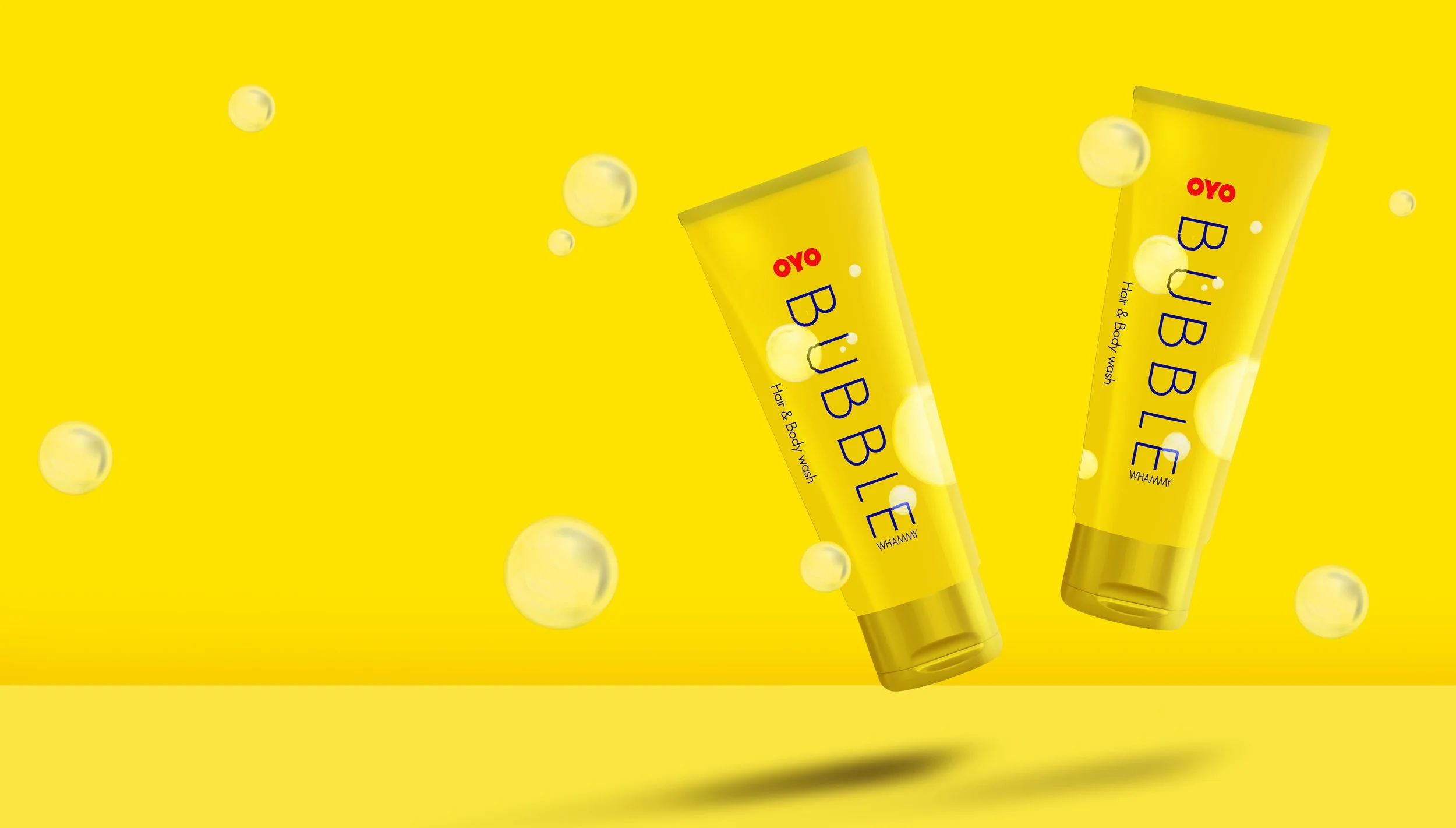
Product
OYO Bubble Whammy. Even the in-room amenities got their own sub-brand — hair and body wash designed with the same brand rigour as any property-level product, sitting inside the OYO house alongside Townhouse and Silverkey.
Nine curated stay concepts. The training data for a house of brands.
Before OYO became PRISM, it had to become a company that could hold more than one brand. That capacity wasn't automatic — it had to be built, one sub-brand at a time.
Over several years, I led the conception of nine curated stay concepts inside the OYO portfolio — each with a distinctive look, feel, price point, and audience. Together they laid the groundwork for the eventual house-of-brands model that PRISM formalised.
For each: nomenclature, positioning, visual identity, guest experience touchpoints, and in many cases the service model itself — from the front-of-house welcome to the room type mix to the check-in flow.
OYO's original model was a single brand serving as an umbrella over wildly heterogeneous inventory. That worked while the company was growing volume in a single segment. It stopped working the moment the company started acquiring, converting, or building properties that didn't belong under the mother brand at all.
Each sub-brand solved a specific version of that problem:
The house-of-brands strategy PRISM formalised was reverse-engineered from these.
The nine sub-brands were, in retrospect, the training data for the eventual PRISM rebrand. They taught the organisation how to run more than one identity at a time. How to build an internal brand governance system that could hold multiple standards. How to make architectural decisions about where a new property should live — under which brand, at which price, with what design language.
None of that muscle existed at the start. All of it was in place by the time it was needed.